

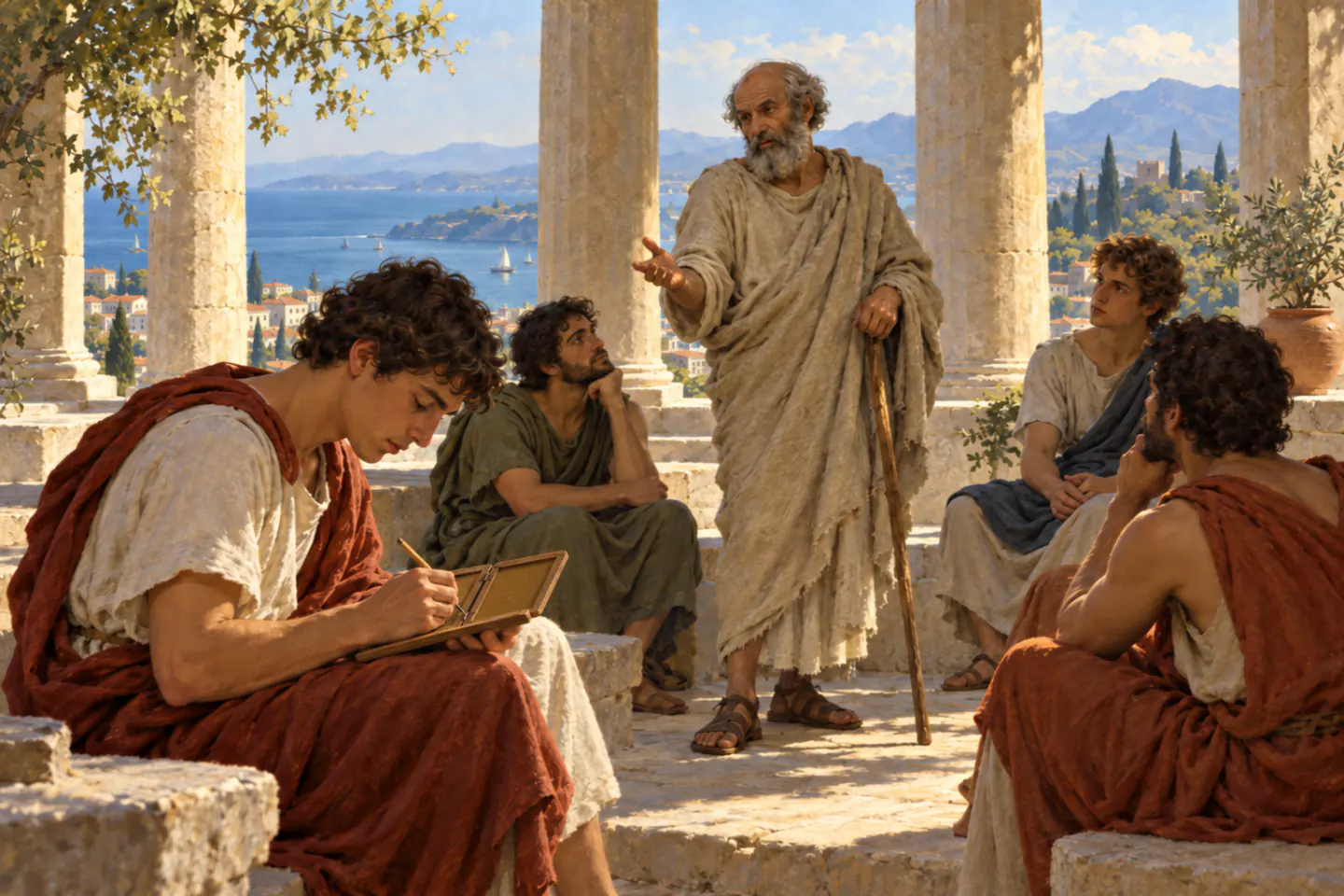

Among the things Marcus Aurelius gives thanks for in his Meditations is an unassuming item: a bundle of notes his teacher passed on to him from his own collection. It was not a book in the modern sense but a record of lessons given by a former slave named Epictetus. Decades later, as emperor in the army camps along the Danube, Marcus Aurelius kept returning to those notes.
Epictetus is often called “the slave who taught an emperor.” It sounds good, but it is not quite accurate, because the two men never met. Whatever Marcus Aurelius knew of Epictetus, he knew from the written word.
That is exactly what makes the story so appealing. It shows how a teaching can carry on across generations without teacher and student ever sitting in the same room. And if you read closely, you notice something else: when Marcus Aurelius quotes Epictetus, he is strikingly often thinking about transience.
Did Marcus Aurelius Meet Epictetus? No, He Knew Only His Words
Epictetus died around AD 135, when Marcus Aurelius was still a boy. There is no evidence that they ever met. Yet the emperor himself testifies that Epictetus shaped him, right at the start of the Meditations. Book 1 is a kind of list of thanks, in which Marcus Aurelius goes through the people to whom he owes something. Of his Stoic teacher Quintus Junius Rusticus, he writes, among other things:
“… to read carefully, and not to be satisfied with a superficial understanding of a book; … and to have become acquainted with the notes of Epictetus, which he gave me from his own collection.”
Marcus Aurelius, Meditations, 1.7
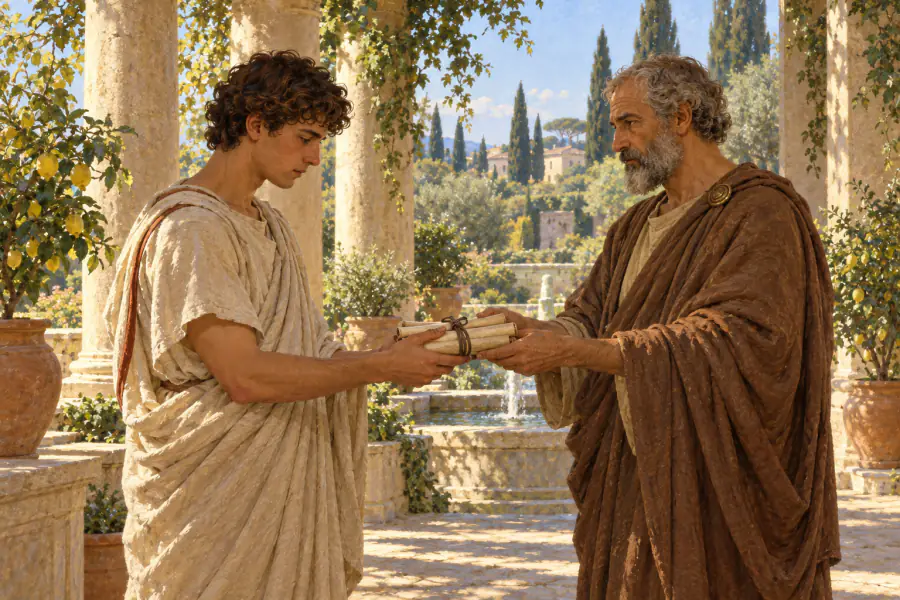
Two things strike me about this passage. The first is the order. Marcus Aurelius thanks Rusticus for the advice to read thoroughly, and immediately afterwards for the book on which he could put that advice to the test. Rusticus gave him not just a text but also the attitude with which to read it. In the same sentence, incidentally, he says he learned from Rusticus not to agree too hastily with those who talk too much. If you scroll through feeds full of Stoic quote cards today, that advice is well worth keeping.
The second is a single word. The Greek text has hypomnemata: notes, reminders, records kept for one’s own use. The word fits precisely, because Epictetus himself never published a line.
Who Was Epictetus? A Teacher Who Wrote Nothing Down
Alongside Seneca and Marcus Aurelius, Epictetus is counted among the three great Stoics of the Roman imperial era. He was born around the year 50 in Hierapolis, in what is now western Turkey. He came to Rome as a slave, in the household of Epaphroditus, an influential freedman in Nero’s service. He was lame; whether through illness or mistreatment, even the ancient sources disagree. He studied philosophy with the Stoic Musonius Rufus, was later freed, and taught in Rome himself until the emperor Domitian banished the philosophers from the city around the year 93. Epictetus went to Nicopolis in Greece and founded a school there.
He wrote nothing. His student Arrian recorded the lessons, as word for word as he could and, by his own account, for himself, to preserve his teacher’s thoughts. Of these Discourses, four books survive out of an original eight. The Handbook, Epictetus’ best-known work today, is likewise a short selection that goes back to Arrian.
The result is a remarkable chain: oral teaching, a student’s record of it, a teacher’s collection and, finally, an emperor’s notebook. Looked at closely, the Meditations are a notebook that learned from another notebook.
Where Marcus Aurelius Mentions Epictetus by Name
If you search the twelve books of the Meditations for Epictetus’ name, you find it, apart from the list of thanks, in Book 4, Book 7 and Book 11. Book 4 says:
“You are a little soul carrying a corpse around, as Epictetus used to say.”
Marcus Aurelius, Meditations, 4.41
The image is less harsh than it first appears. The Greek uses a diminutive, psychárion, and the word sounds tender and sober at the same time. The soul is not being despised; it is being put into proportion: something small that carries something perishable along with it.
In Book 7, Epictetus appears in a row with Socrates and the Stoic Chrysippus: “How many a Chrysippus, how many a Socrates, how many an Epictetus has time already swallowed up!” Of all people, Marcus Aurelius counts the very man whose notes shaped him among those who have long since vanished.
And in Book 11, in sections 33 to 38, the emperor strings together sayings that can be traced to Epictetus, specifically to chapters 3.24 and 3.22 of the Discourses. He records them almost without comment, as if he had opened the notes and copied out what mattered to him.
If you add up everything Marcus Aurelius recorded from Epictetus in this way, you arrive at eight passages: one each in Book 4 and Book 7, and six in Book 11. Five of them are about transience: the corpse (4.41), all-devouring time (7.19), the fig in winter and the child who is no longer given to you (11.33), the kiss (11.34), and the grape that becomes a raisin (11.35). Only three concern what Epictetus is usually quoted for today: free will, the art of assent, and the question of whether you keep your sanity (11.36 to 11.38).
This proves nothing. Marcus Aurelius probably drew on Epictetus often without naming him, and scholars attribute further passages to Epictetus. My count rests only on the passages marked as Epictetus quotations in the standard editions. But it does raise a question: why would an emperor who could have taken so much from Epictetus’ teaching copy out these sentences in particular?
Memento Mori Without Coldness: Chapter 3.24 of the Discourses

Part of the answer lies in the chapter the emperor draws on. There, Epictetus speaks about things that are not in our power, and he becomes surprisingly concrete. When you kiss your child, your brother or a friend, he says, do not give your imagination free rein. Hold it in check, like those who stand behind a general in a triumphal procession and remind him that he is mortal. What you love has not been given to you forever, but for a set time, like a fig or a grape in its season. Anyone who longs for them in winter is a fool.
Then comes the sentence Marcus Aurelius takes into his notebook:
“When a man kisses his child, said Epictetus, he should whisper to himself: ‘Tomorrow perhaps you will die.’ But those are words of bad omen. ‘No word is a word of bad omen,’ said Epictetus, ‘which expresses any work of nature. Otherwise it would also be a word of bad omen to speak of the ears of corn being reaped.’”
Marcus Aurelius, Meditations, 11.34
Three things about this strike me as remarkable. First, a detail the emperor leaves out: Epictetus asks what harm there could be in saying this sentence, while kissing, in a lisping voice, that is, in the tone we use when speaking to small children. The exercise does not take the place of tenderness; it happens in the middle of it. Second, the objection is allowed to stand. Marcus Aurelius writes down the unease as well, and Epictetus answers with an image from farming: the reaping of the corn is no misfortune but its natural course. Third, the same chapter contains an instruction that the Meditations seem to follow. Keep these thoughts ready, Epictetus says, by day and by night: write them down, read them, and talk them over with yourself and with others.
That is exactly what Marcus Aurelius did. The Meditations are, among other things, an emperor’s answer to that instruction.
Why This Is Not Cold, and What It Offers You Today

You probably know the criticism of Stoicism: that it makes people emotionally cold, plays down loss, and appeals to those who do not want to cry. With an exercise like this one, the suspicion seems natural. Telling yourself, as you kiss your child, that they could die looks like an attempt to arm yourself against your own feelings.
The text suggests the opposite. The exercise takes place during the tenderness, not instead of it, and its aim is greater attention. If, in a given moment, you truly perceive your child as vulnerable and mortal, you are unlikely to be glancing at your phone in that moment. This same kind of attention is what my article on doomscrolling is about. And the Meditations are hardly the work of an unfeeling man. They come from someone who had to remind himself again and again that time with other people is shorter than it feels in everyday life.
Perhaps you know the feeling: at some point you carry your sleeping child from the car to bed for the last time, and only months later do you realise it was the last time. There is the last phone call with your grandmother that sounded like any other. There is the voice message from someone who has died, which you cannot delete and yet no longer play. Epictetus’ exercise brings this insight forward. It lets you recognise what is precious not only in hindsight, but while the person is still standing in front of you.
Psychology knows a related effect. In 2008, Minkyung Koo, Sara Algoe, Timothy Wilson and Daniel Gilbert asked students to write about a positive event in their lives: either about how it came about, or about how it might never have happened. Those who imagined it had never happened felt better afterwards, even though participants had expected the opposite. In another variation, the subject was their own romantic relationship: those who pictured never having met their partner were afterwards more satisfied with the relationship than those who retold how they had met.
The study examined neither Epictetus nor the thought of a future loss. It shows only a related mechanism: we value something more when, for a moment, we stop taking it for granted. I would not push the parallel any further than that.
How Marcus Aurelius Made the Exercise His Own
For Marcus Aurelius, Epictetus’ exercise was no thought experiment. By the usual count, his wife Faustina bore at least fourteen children, including two sets of twins, and only six of them reached adulthood. In the same list of thanks in Book 1, the emperor thanks his teacher Apollonius for teaching him to remain the same person even at the loss of a child. A sentence like that is not written from theory.
Book 9 shows what Epictetus’ exercise became in his hands. The wording is the emperor’s own:
“Another prays thus: How shall I not lose my little son? You must pray thus: How shall I not be afraid to lose him?”
Marcus Aurelius, Meditations, 9.40
Here lies a subtle but important shift. Epictetus describes how to deal with the fact that people die. Marcus Aurelius asks what the fear of that loss is doing to him. He does not ask to be spared, nor does he pretend that it would leave him indifferent. He simply does not want the fear to rule him.
The Same Teaching, Different Tasks: The Slave and the Emperor
Epictetus was a slave, lame, and for a time banished from Rome. For him, the distinction between what is in our power and what is not was also a refuge. Today it is often called the “dichotomy of control.” “No one can rob us of our free will” (11.36): that is the voice of someone from whom almost everything else could be taken.
For Marcus Aurelius, the same teaching had a different task. He held power over life and death, over armies and an empire. The danger he faced was less the loss of his inner freedom than the loss of his sense of proportion. In his hands, the teaching therefore works like a brake. That is my interpretation, not an established fact, but it would explain why his notes so rarely lecture and so often examine. Epictetus speaks to his students; Marcus Aurelius speaks to himself.
You can even hear the difference in tone. In the same chapter 3.24, Epictetus rounds on his listener with something like: Will you never stop being a foolish child? Do you not know that someone who behaves childishly looks all the more ridiculous the older he gets? The emperor, by contrast, turns the rebuke into a question addressed to himself, as in 9.40. He does not scold; he examines.
The French historian of philosophy Pierre Hadot argued in his book on the Meditations (The Inner Citadel) that Marcus Aurelius works through Epictetus’ three areas of practice again and again: desire, action and assent. The point is to accept what happens, to deal justly with others, and to examine your own judgments. If that is right, then the Meditations are not a separate philosophy for rulers, but Epictetus’ teaching as read by someone who could not escape it.
Three Stoic Exercises from an Emperor’s Notebook
The following suggestions are not a scientifically tested method. They carry what Marcus Aurelius did with Epictetus’ notes into your everyday life. If you are carrying a loss of your own right now, go gently and set the second exercise aside for the time being.
1. Copy It Out and Reply
Find a sentence that you came across in a book, a conversation or a message and that will not let you go. Copy it out in full, including the objection if there is one, and beneath it write a single line in reply. That is exactly what the section in Book 11 looks like: excerpts, barely any commentary. After a few weeks, you will have a small collection that tells you more about yourself than you expect.
Online, the opposite usually happens. Quote cards show the beautiful sentence and leave out the objection. Marcus Aurelius wrote it down too. If you would like to read the Meditations this way, slowly and with a pen in your hand, you can find my translation of the Meditations on Amazon. Its short, numbered sections practically invite you to read and answer them one at a time.
2. One Goodbye, One Thought
The next time you say goodbye to someone, close the door behind a visitor or end a phone call, take ten seconds. Say to yourself: “This person is mortal, and right now they are here.” That is all it takes. You do not have to feel anything in particular or say anything aloud. Just notice whether your goodbye changes: whether you look a moment longer, or leave your phone in your pocket a little while more.
3. Turn a Wish into an Attitude
Take a wish that is on your mind right now, such as “I hope I get the job” or “I hope the test results are fine.” Reshape it the way Marcus Aurelius does in 9.40: “How do I stay myself if things turn out differently?” You are not giving up the wish. You are only asking who you want to be if the answer is not the one you hoped for. Write the new question down and let it stand beside the old one for a few days.
A Short Reading Path Through the Meditations
Perhaps you now feel like exploring the text yourself. You do not need to read the Meditations from the first page to the last for that. The following path takes you, in a single afternoon, through the traces Epictetus left in Marcus Aurelius. If you would then like to meet Epictetus in the original, the best place to start is chapter 3.24 of his Discourses, which you can read in an evening.
What Remains of Notebooks
One detail of this story stays with me. In Book 7, Marcus Aurelius counts Epictetus among the people whom time has already swallowed up. And he is right: Epictetus left no book, not a single line in his own hand. Yet we still read him today, because a student took notes, a teacher kept them, and an emperor copied out what would not let him go.
Philosophy that endures often consists not of grand systems but of notes: of what someone wrote down for themselves because they needed it. Stoicism in the Roman imperial era was, as Hadot shows, less a doctrinal edifice than a practice of living, and writing was part of that practice. That is one more reason it is worth reading the Meditations in full and not just their most famous lines. They are not a reference work but the inner dialogue of a man who meant it. If you would like to continue that dialogue, you will find it in my translation of Marcus Aurelius’ Meditations. Begin with a single passage, copy it out, and answer it.
Perhaps one day something will come of it that another person will want to pass on, too.